
Key Takeaways
- A federal target letter signals you are a primary suspect in a federal investigation, often in its final stages.
- Immediate legal counsel from an experienced white collar defense attorney in Utah is crucial to protect your rights.
- An attorney can engage with federal prosecutors pre-indictment, review evidence, and potentially prevent charges or negotiate favorable outcomes.
- Ignoring a target letter or speaking with agents without counsel can severely jeopardize your defense.
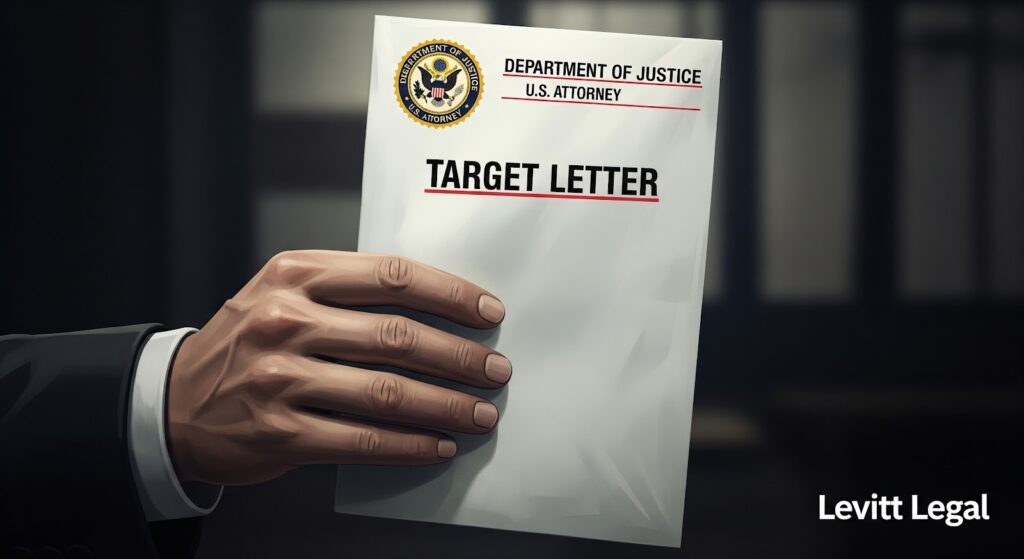
What a Federal Target Letter Means for You
Receiving a formal letter from the U.S. Attorney’s Office can be a deeply unsettling experience. This document, known as a federal target letter, is not a casual inquiry; it is a direct notification that you are the focus of a federal criminal investigation. It formally identifies you as a “target,” meaning federal prosecutors believe they have substantial evidence linking you to the commission of a crime.
It’s crucial to understand the distinction between a target, a subject, and a witness. A witness has information relevant to an investigation. A subject is someone whose conduct is within the scope of the grand jury’s investigation. A target, however, is at the top of the pyramid—the person the government intends to indict. These letters are most common in complex financial cases, making it essential to seek counsel for understanding white collar charges and their severe implications.
Why Receiving a Federal Target Letter is a Serious Legal Threat
A federal target letter is a clear and direct warning shot. It signifies that a federal investigation, which may have been ongoing for months or even years without your knowledge, is now reaching its conclusion. The Assistant U.S. Attorney (AUSA) handling the case has reviewed the evidence gathered by agencies like the FBI or IRS and has concluded there is probable cause to seek an indictment against you from a grand jury.
The stakes in federal court are significantly higher than in state proceedings. Federal prosecutors have vast resources, and the sentencing guidelines are often much stricter. The letter essentially provides a final, narrow window of opportunity for your attorney to intervene before formal charges are filed. This pre-indictment phase is arguably the most critical juncture in your entire case, where a skilled defense can make the most significant impact. Understanding the differences between federal vs. state criminal defense highlights why specialized experience is non-negotiable.
Common White Collar Cases Leading to Federal Target Letters in Utah
Federal agencies in Utah actively investigate a wide range of complex financial crimes. While any federal offense can result in a target letter, they are frequently associated with white collar cases where investigators have spent considerable time tracing financial records and digital evidence. Some of the most common Utah white collar charges that trigger these letters include:
- Fraud: This broad category includes mail fraud, wire fraud, bank fraud, and securities fraud. Any scheme that uses interstate wires or mail to deceive for financial gain can lead to federal fraud charges.
- Embezzlement: The unlawful taking of property by someone to whom it was entrusted, often seen in corporate or non-profit settings.
- Money Laundering: Disguising the origins of illegally obtained money. A money laundering defense requires deep knowledge of financial regulations.
- Tax Crimes: Including tax evasion, filing false tax returns, or failure to file, often investigated by IRS Criminal Investigation (IRS-CI).
- Federal Program Fraud: Defrauding government programs like Medicare, Medicaid, or COVID-19 relief funds (e.g., PPP loans).
- Public Corruption and Bribery: Offenses involving public officials who accept or solicit anything of value in exchange for official action.
Why Immediate Legal Representation is Essential After a Target Letter
Upon receiving a target letter, your first and only call should be to an experienced federal target letter lawyer. Attempting to contact federal agents or the prosecutor on your own is a catastrophic mistake. Anything you say can and will be used against you. Federal agents are highly trained in interrogation techniques designed to elicit incriminating statements, even from the innocent.
Early intervention by a qualified attorney is your best defense. A lawyer can immediately open a line of communication with the prosecutor on your behalf, signaling that you are taking the matter seriously and are represented by competent counsel. This prevents you from making missteps and allows your attorney to begin gathering information and formulating a pre-indictment strategy. As outlined in what to do if you’re charged with a white collar crime, immediate legal guidance is paramount. Time is of the essence, as these letters often have deadlines for a response.
How a Federal Lawyer Can Intervene Before Indictment
The pre-indictment phase is a proactive period where a skilled federal defense attorney can potentially alter the course of the investigation. Instead of waiting to react to an indictment, your counsel takes immediate action. This can include:
- Communicating with Federal Agents and Prosecutors: Your attorney becomes the sole point of contact, protecting you from direct questioning and potential self-incrimination.
- Determining Your Status: The lawyer will confirm your status as a target and try to understand the scope and nature of the government’s investigation.
- Reviewing Evidence: Counsel may be able to arrange a meeting with the prosecutor to review key evidence, assess the strength of the government’s case, and identify potential weaknesses.
- Managing Grand Jury Proceedings: If you are subpoenaed to testify before the grand jury, your attorney will prepare you extensively and can assert your Fifth Amendment rights to prevent you from providing testimony that could incriminate you.
- Negotiating with the U.S. Attorney’s Office: This is perhaps the most critical role. Your lawyer can present mitigating evidence, challenge the government’s legal theories, or negotiate for a non-prosecution agreement, reduced charges, or a more favorable plea deal before an indictment is ever returned.
Critical Mistakes to Avoid When You Receive a Target Letter
The actions you take—or fail to take—after receiving a target letter can have lasting consequences. It is imperative to avoid these common and costly mistakes:
- Contacting Investigators Directly: Do not call the agent or prosecutor listed on the letter. This is not a situation you can talk your way out of.
- Destroying or Altering Documents: This can lead to separate, serious charges for obstruction of justice. Assume everything is discoverable.
- Discussing the Investigation: Do not talk about the letter or the investigation with colleagues, friends, or family. These individuals could become witnesses for the prosecution.
- Ignoring Deadlines: The letter may contain deadlines for your attorney to respond. Ignoring it will not make the problem disappear; it will only lead to an indictment without your side being heard.
- Assuming Cooperation Guarantees Protection: Cooperating without legal counsel is a trap. Any “proffer” or statement you provide can be used against you if negotiations fail. For more guidance, see our criminal defense FAQs.
Utah-Specific Considerations for Federal Target Letters
In Utah, federal investigations are handled by the U.S. Attorney’s Office for the District of Utah, with primary offices in Salt Lake City. Residents of Salt Lake County, Summit County, and surrounding areas fall under this jurisdiction. Target letters issued here are typically the result of investigations by powerful federal agencies, including:
- The Federal Bureau of Investigation (FBI)
- IRS Criminal Investigation (IRS-CI)
- Homeland Security Investigations (HSI)
- The Drug Enforcement Administration (DEA)
- The Secret Service
Federal prosecutors in Utah are known for being thorough, aggressive, and well-prepared. They do not issue target letters unless they are confident in their case. Having a local white collar target letter attorney who understands the tendencies of the District of Utah’s prosecutors and is respected within the federal courthouse can be a significant advantage during pre-indictment negotiations.
Building Your Defense: Pre-Indictment Strategies for White Collar Cases
An effective pre-indictment defense is not passive. Your attorney will work diligently to dismantle the government’s case before it ever reaches a jury. Key strategies include identifying weaknesses in the prosecution’s evidence, challenging the legality of search warrants or subpoenas, and presenting mitigating evidence that prosecutors may have overlooked. This can involve coordinating with forensic accountants or financial experts to offer alternative interpretations of complex financial data. The goal is to create enough doubt to convince the prosecutor that pursuing an indictment is not in the interest of justice or that their chances of a conviction at trial are low. In some cases, this can lead to alternatives to criminal charges, such as civil settlements.
When to Contact a Federal Target Letter Attorney in Utah
Urgency cannot be overstated. You should contact an experienced federal criminal defense attorney the moment you receive a target letter. Even if you only suspect you are under investigation—for instance, if federal agents have contacted your colleagues or served subpoenas on your bank—it is wise to seek legal counsel. Early engagement allows your attorney the maximum amount of time to prepare a defense and engage with prosecutors. If you are facing federal charges or the threat of them, do not wait. Your reputation, freedom, and financial future are on the line.
Proactive Defense Starts Now: Secure Your Future
Don’t face a federal investigation alone. The moments after receiving a target letter are critical. Take the first step toward protecting yourself and contact Levitt Legal immediately.
FAQs
What does a federal target letter mean?
Answer: A federal target letter is a formal notification from a U.S. Attorney’s Office indicating that you are the subject of a federal criminal investigation and that a grand jury has evidence linking you to a federal crime. It means you are likely to be indicted unless an attorney can intervene effectively.
Do I need a lawyer if I get a federal target letter?
Answer: Absolutely, yes. Receiving a federal target letter is an extremely serious matter, signaling that you are at high risk of indictment. You should immediately contact an experienced federal white collar defense attorney before speaking with any federal agents or prosecutors.
Can a lawyer stop charges after a federal target letter?
Answer: While there are no guarantees, an experienced federal white collar attorney can often intervene at the pre-indictment stage to influence charging decisions. This may include presenting mitigating evidence, negotiating with prosecutors, or demonstrating weaknesses in the government’s case to prevent an indictment or secure reduced charges.
What happens if I ignore a federal target letter?
Answer: Ignoring a federal target letter is one of the most detrimental actions you can take. It will not make the investigation go away. Instead, it signals non-cooperation and leaves you vulnerable to indictment without any legal representation or negotiation on your behalf, potentially leading to more severe consequences.
How much time do I have to respond to a federal target letter?
Answer: Federal target letters often include a deadline for your attorney to contact the prosecutor. While there might be some flexibility, these deadlines are serious. It is crucial to engage legal counsel immediately so they can establish communication and begin strategizing your defense without delay.
What agencies send target letters in Utah?
Answer: In Utah, federal target letters typically originate from the U.S. Attorney’s Office for the District of Utah, following investigations conducted by various federal agencies. Common agencies involved in white collar investigations include the FBI, IRS Criminal Investigation (IRS-CI), Homeland Security Investigations (HSI), Secret Service, and other specialized inspector general offices.